|
Atmospheric and Space Electrodynamic Coupling
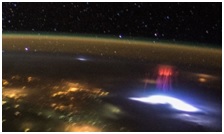 The Atmospheric and Space Electrodynamic Coupling Group "ACATMOS" is one of the research lines of the Heliophisicas, Planetary Sciences and Aeronomy Division (DIHPA) of INPE. ACATMOS is the first and, to date, the only group in Latin America that studies the electrodynamic coupling of all layers of the atmosphere and the atmospheric system with the region of near-Earth space. This coupling is signaled by Transient Luminous Events "ELTs", of which Sprites are the best known, and by High Energy Emissions from Thunderstorms "ALETs", such as Terrestrial Gamma-Ray Flashes "FGTs". Collectively, both classes of phenomena are called Signaling Effects of Electrodynamic and Space Coupling "FADAS". The Atmospheric and Space Electrodynamic Coupling Group "ACATMOS" is one of the research lines of the Heliophisicas, Planetary Sciences and Aeronomy Division (DIHPA) of INPE. ACATMOS is the first and, to date, the only group in Latin America that studies the electrodynamic coupling of all layers of the atmosphere and the atmospheric system with the region of near-Earth space. This coupling is signaled by Transient Luminous Events "ELTs", of which Sprites are the best known, and by High Energy Emissions from Thunderstorms "ALETs", such as Terrestrial Gamma-Ray Flashes "FGTs". Collectively, both classes of phenomena are called Signaling Effects of Electrodynamic and Space Coupling "FADAS".
http://www.dae.inpe.br/acatmos/
|
|
Upper Atmosfere
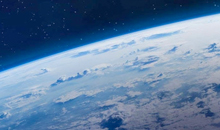 The research group on Physics of the Upper Atmosphere is part of the Heliophysics, Planetary Sciences and Aeronomy Division (DIHPA), of the National Institute for Space Research (INPE). Our research activities began in 1968 with the assembly of a ruby laser radar (LIDAR) for monitoring stratospheric aerosols. The research group on Physics of the Upper Atmosphere is part of the Heliophysics, Planetary Sciences and Aeronomy Division (DIHPA), of the National Institute for Space Research (INPE). Our research activities began in 1968 with the assembly of a ruby laser radar (LIDAR) for monitoring stratospheric aerosols.
http://www.dae.inpe.br/fisica-da-alta-atmosfera/
|
|
Lightning Monitoring and Physics

INPE monitors lightning activity in Brazil using two ground-based sensor networks on global and regional scales, as well as optical sensors aboard the International Space Station (ISS) and the geostationary satellite GOES-16. Together, these systems provide detailed, real-time information on lightning occurrences across the country, enabling climatological analyses, forecasts of severe atmospheric events, climate projections, and studies of atmospheric interactions.
The research also employs high-speed cameras, electric field sensors, photometers, and a variety of auxiliary sensors, which offer insights into the processes of lightning formation and propagation and their connection with ground structures. This enhances understanding of the physics of the phenomenon, contributing to the improvement of lightning protection systems and advancing studies on their relationships with atmospheric chemistry, wildfire occurrences, and the generation of Gamma and X-ray radiation.
|
|
Geomagnetism
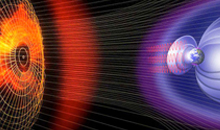 Geomagnetism studies developed at INPE are based on measurements of temporal variations in the Earth's magnetic field observed on the Earth's surface. These variations result from the sum of two distinct contributions: one of external origin (considered primary and generated by electric currents flowing in the ionosphere and magnetosphere) and another internal (secondary, induced by external variations in conductive materials inside the Earth). Geomagnetism studies developed at INPE are based on measurements of temporal variations in the Earth's magnetic field observed on the Earth's surface. These variations result from the sum of two distinct contributions: one of external origin (considered primary and generated by electric currents flowing in the ionosphere and magnetosphere) and another internal (secondary, induced by external variations in conductive materials inside the Earth).
http://www.dge.inpe.br/geoma/
|
|
Ionosphere
 The Ionosphere Research line is part of INPE's Heliophysics, Planetary Sciences and Aeronomy Division (DIHPA). This research began in 1963, with the reception of satellite signals. Ionospheric soundings (using ionosondes) began in Cachoeira Paulista, SP, in 1973, and in Fortaleza, CE, in 1975. The Ionosphere Research line is part of INPE's Heliophysics, Planetary Sciences and Aeronomy Division (DIHPA). This research began in 1963, with the reception of satellite signals. Ionospheric soundings (using ionosondes) began in Cachoeira Paulista, SP, in 1973, and in Fortaleza, CE, in 1975.
http://www.dae.inpe.br/ionosfera/
|
|
Atmospheric Luminescence
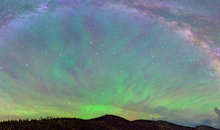 The Atmospheric Luminescence group "LUME" is one of the research lines of the Heliophysics, Planetary Sciences and Aeronomy Division (DIHPA) of INPE. The main topics of study are: physical processes (temperature, winds and wave propagation) and photochemical processes (reactions of atomic oxygen, hydrogen, ozone and ions) in the upper atmosphere, from 80 to 300 km high, through the observation of atmospheric luminescence. The optical emissions of atomic oxygen, OI 557.7 nm and OI 630.0 nm, sodium at 589 nm, hydroxyl OH(6.2) at 835 nm and molecular oxygen O2 atm.(0.1) at 866 nm are being monitored. The Atmospheric Luminescence group "LUME" is one of the research lines of the Heliophysics, Planetary Sciences and Aeronomy Division (DIHPA) of INPE. The main topics of study are: physical processes (temperature, winds and wave propagation) and photochemical processes (reactions of atomic oxygen, hydrogen, ozone and ions) in the upper atmosphere, from 80 to 300 km high, through the observation of atmospheric luminescence. The optical emissions of atomic oxygen, OI 557.7 nm and OI 630.0 nm, sodium at 589 nm, hydroxyl OH(6.2) at 835 nm and molecular oxygen O2 atm.(0.1) at 866 nm are being monitored.
http://www.dae.inpe.br/aeroluminescencia/
|
|
Magnetosphere-Heliosphere
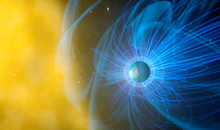 The study of the physics of the magnetosphere and its extension to interplanetary medium, solar and heliospheric phenomena is currently of great interest for understanding the fundamental characteristics of the so-called Space Weather. In this line of research, basic processes of the sun-interplanetary medium-magnetosphere coupling are studied, using collaborations with several national and international groups, involving theoretical, numerical and computational approaches, as well as modeling through data collected by spacecraft, satellites and terrestrial monitoring. The study of the physics of the magnetosphere and its extension to interplanetary medium, solar and heliospheric phenomena is currently of great interest for understanding the fundamental characteristics of the so-called Space Weather. In this line of research, basic processes of the sun-interplanetary medium-magnetosphere coupling are studied, using collaborations with several national and international groups, involving theoretical, numerical and computational approaches, as well as modeling through data collected by spacecraft, satellites and terrestrial monitoring.
|
|
Middle and Lower Atmosphere
 Research focuses mainly on the study of minor gases of interest to the Biosphere, such as O3, CO2, CO, N2O, CH4 and SO2, both theoretically, through modeling of photochemistry and dynamics, and experimentally through monitoring stations (Dobson spectrophotometer, gas chromatography) or on board rockets (optical probes) and balloons (EEC probes). Nuclear Geophysics and computational methods are also used to study phenomena of cosmogeophysical and planetary interest. Research focuses mainly on the study of minor gases of interest to the Biosphere, such as O3, CO2, CO, N2O, CH4 and SO2, both theoretically, through modeling of photochemistry and dynamics, and experimentally through monitoring stations (Dobson spectrophotometer, gas chromatography) or on board rockets (optical probes) and balloons (EEC probes). Nuclear Geophysics and computational methods are also used to study phenomena of cosmogeophysical and planetary interest.
|