Notícias
ANM Joins Unprecedented Global Initiative to Transform Small-Scale Mining
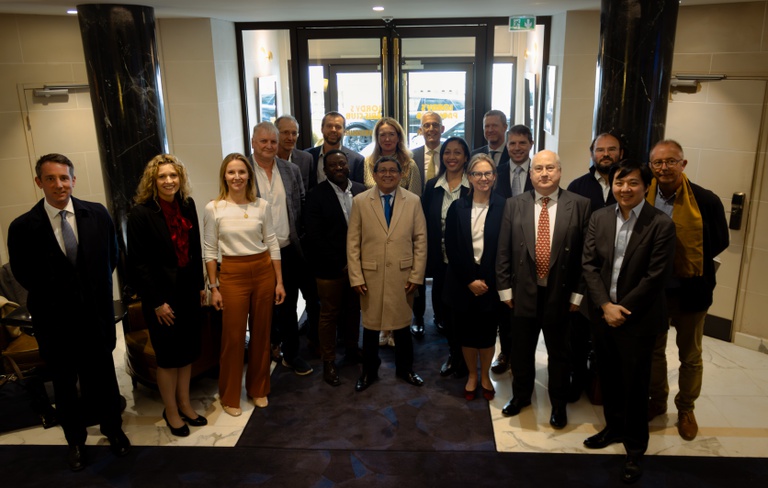
Last week in Paris, a profound milestone began to form for the future of global mineral governance. The National Mining Agency (ANM) was invited to a preparatory meeting for the creation of the Global Coalition for Action on Artisanal and Small-scale Gold Mining (ASGM), with the participation of Director-General Mauro Sousa. For the first time, national governments, the World Bank, the World Gold Council, the Intergovernmental Forum on Mining, Minerals, Metals and Sustainable Development (IGF), linked to the Organisation for Economic Co-operation and Development (OECD), private companies, and civil society representatives are uniting in a coordinated action to systematically face the challenges and opportunities of this complex sector.
The new Coalition was conceived as a multi-sectoral intergovernmental structure, with a technical basis and political coordination. The ANM was invited to participate in the creation of the global Steering Committee that will define the guidelines and criteria for membership and operation. The proposal is for countries like Brazil to formally join this alliance, with the goal of raising regulatory standards and combating the fragmentation of international gold rules, which are currently exploited by criminal networks and speculative operations.
Millions of people worldwide depend directly or indirectly on artisanal and small-scale mining, often in precarious conditions with risks to health, the environment, and human rights. Responsible for about 20% of the gold produced globally, ASGM operates mostly outside legal and regulatory frameworks. This informality creates room for environmental violations, extensive use of mercury, worker exploitation, tax evasion, and a growing connection to organized crime and money laundering networks.
"It's not just about regularizing artisanal mining. It's about building pathways to dignity, public health, and the protection of biodiversity. Brazil has a decisive role in this agenda, and the ANM is ready to contribute with a technical, balanced regulation integrated with other government areas," stated Mauro Sousa, Director-General of the ANM.
What's at Stake
ASGM is a sector that is at once one of the last frontiers of subsistence for thousands of families in peripheral territories, and also one of the most infiltrated by illegal networks. This ambivalence demands a new type of international cooperation that links regularization with local development, enforcement with environmental education, and governance with financial innovation.
The Global Coalition is inspired by the Multi-Stakeholder Partnership Initiative (MSPI), developed by the World Bank and the World Gold Council. The proposal is to promote pilot actions in key countries, coordinate international financing, strengthen gold traceability, and integrate small productive operations into legal global chains, respecting the environment and the rights of communities.
The Risks of Lacking Global Regulation
The spike in the international price of gold in recent years has spurred a global rush for informal extraction. In many countries, including Brazil, criminal networks have begun to infiltrate mining territories, promoting land grabbing, slavery-like labor, and the large-scale use of mercury. The absence of international standardization in gold control and pricing facilitates the flow of illegal gold into legal markets, making enforcement difficult and boosting money laundering on a global scale.
According to the World Gold Council, over 80% of global ASGM gold production does not pass through formal channels. The ANM's entry into the international debate is an opportunity to propose regulatory solutions that ensure traceability, transparency, and legal certainty for miners and buyers.
One of the positive impacts of the coalition will be the reduction of mercury use in mining. ASGM is responsible for a significant portion of the global emissions of this toxic metal. Mercury is used in a rudimentary way to separate gold from gravel and water, contaminating rivers, fish, workers, and riverside populations.
The introduction of clean technologies, access to financing, and technical assistance for formal miners will allow for progress in complying with the Minamata Convention and generate a virtuous cycle of health and environmental sustainability in mining territories.
Brazilian Actions and Challenges
In recent years, Brazil has adopted a series of regulatory measures to combat illegal mining and make control of the gold supply chain more rigid. The Yanomami humanitarian crisis prompted a coordinated institutional response, including the requirement for an Electronic Invoice for gold transactions and the end of the presumption of good faith in proving the origin of the metal, as per a Supreme Federal Court decision.
The ANM, in conjunction with the Central Bank, established financial control rules and published Resolution No. 129/2023, which obliges the sector to adopt anti-money laundering and anti-terrorism financing (AML/CTF) policies. The Federal Revenue Service intensified enforcement at Guarulhos Airport, resulting in the seizure of gold shipments from Brokerage Houses for Securities and Financial Instruments (DTVMs) without adequate proof of origin.
These integrated actions have also had an impact on official statistics: according to Instituto Escolhas, declared gold production fell by 84% after the measures were initiated. The high international gold price (above US$ 3,500 per ounce) continues to fuel clandestine production, with estimates that 80% of the gold currently traded in the country is outside state control.
Investigations also point to the infiltration of organized crime into the sector. The so-called "narco garimpo," with factions like the PCC operating, uses gold as a medium of exchange for arms and drugs, diverting the metal through illegal routes without paying taxes such as the Financial Compensation for Mineral Exploitation (CFEM), Tax on Financial Operations (IOF), and Income Tax (IR).
To regain control of the formal market, cooperatives and financial institutions advocate for the creation of a state traceability system that would enable the achievement of international credibility, increase enforcement efficiency, and promote the sustainability of the production chain.
Some recommendations from the Agency include the formalization of artisanal and small-scale mining, and the mandatory implementation of robust traceability mechanisms. Also, the strengthening of socio-environmental policies aimed at reducing the use of mercury and adopting responsible practices. The challenge is to ensure that the transition to formality is viable, less bureaucratic, and sensitive to the cultural and social specificities of the territories where artisanal mining takes place.
Brazil's Role
As the largest economy in Latin America and a country with vast areas of informal mining, Brazil is seen as a key country for the success of the Global Coalition. The active participation of the ANM, with the support of the federal government, is essential to structure a National Coalition that can serve as a model for other countries in the Global South.
"The coalition is a historic opportunity for Brazil to lead a new paradigm for small-scale mining: productive, formalized, with respect for the environment and communities. The ANM is committed to putting its technical knowledge at the service of this transformation," highlights Mauro.
Tiago Souza - ANM Press Office