Notícias
“Traceability and interagency coordination are key to tackling illegal gold”

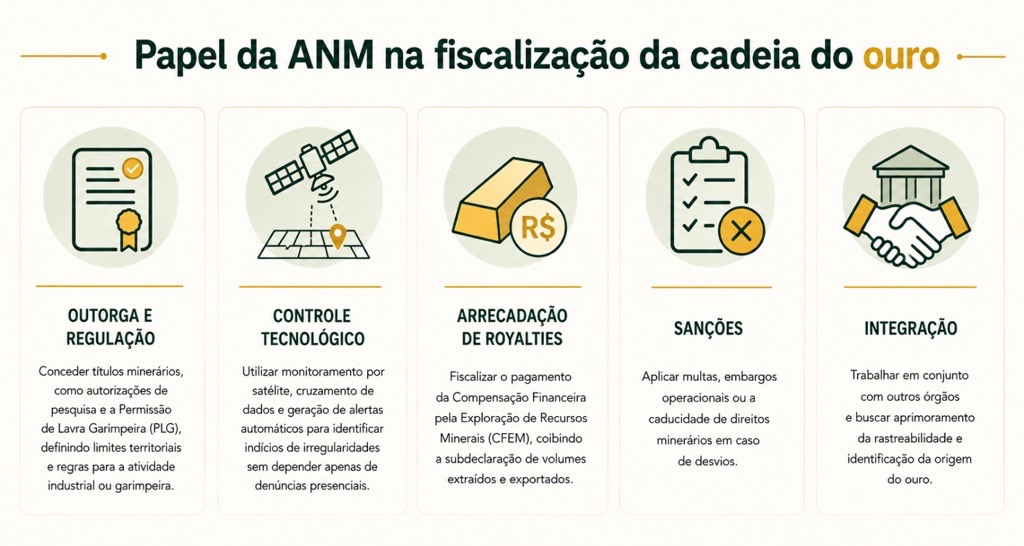
Tackling illegal gold requires traceability and coordination among enforcement agencies. This assessment was presented on Thursday (27) by Fernando Drummond, Superintendent of Inspections at Brazil’s National Mining Agency (ANM), during the EXPOSIBRAM 2026 panel “Controls on Gold Trading in Brazil.” Drummond compared the complexity of monitoring gold to that of overseeing the diamond trade.
According to Drummond, ANM already has experience in certifying the origin of diamonds and monitoring their movement for export. Gold, however, presents an additional challenge: its high financial liquidity. “In some circumstances, gold can be more liquid than money itself,” he added.
Gold recycling also poses challenges for oversight. According to Drummond, addressing the issue requires the ability to track gold from extraction and its first purchase through all subsequent stages of the supply chain. In this context, coordination among the institutions involved is essential.
Sofia Freitas Silva, a Federal Prosecutor in the state of Amazonas, argued that companies should have access to mechanisms for monitoring the entire supply chain, making it easier for them to provide concrete evidence that they have acted in good faith.
Gustavo Geiser, Manager of the Brazilian Federal Police’s Ouro Alvo Program, compared the fight against illegal gold trading to a barrel riddled with holes, requiring simultaneous action on several fronts. Despite the challenges, he said that Brazil has made progress over the past ten years. “There used to be no controls at all,” he said.
Geiser cited the increased transparency provided by systems such as ANM’s SIGMINE. “Access to public data has become more transparent, making it possible to identify problems and implement solutions,” he said.
Geiser stressed, however, that documentation alone is not sufficient to ensure effective traceability. He advocated the use of isotopic, geochemical and morphological analyses to identify the region where the gold was extracted and establish the mineral’s signature. “Through these enforcement efforts, we hope illegal gold will trade at a discount, encouraging those involved in the illegal market to regularize their activities,” he said.
Larissa Rodrigues, Research Director at Instituto Escolhas, advocated a system inspired by Brazil’s controls on the timber trade. It would integrate data, record transactions, issue transport permits and track gold through to export. The proposal would also establish a chain of accountability among the parties involved.
Gilson Gomes Camboimm, representing mining cooperatives, also emphasized the need for coordination among government agencies. In his view, excessive bureaucracy can make illegal activity more attractive. “Communication among enforcement, regulatory and monitoring agencies helps foster compliance,” he said.
Traceability
Fernando Drummond reiterated that progress in traceability does not depend on ANM alone. According to him, all institutions involved, including the Central Bank of Brazil, must work in coordination. The superintendent also warned that budget disruptions undermine planning and the achievement of inspection targets.
Concluding his remarks, Drummond emphasized the importance of tracking the origin of the mineral without turning enforcement into the persecution of workers in the sector. “The idea is to follow the gold, not persecute artisanal miners,” he concluded.
| Iris Vasconcellos Guimarães — ASCOM da Agência Nacional de Mineração |