Notícias
COP 30
Minister Carlos Fávaro Visits AgriZone and Strengthens MAPA’s Presence in a Strategic Venue at COP30
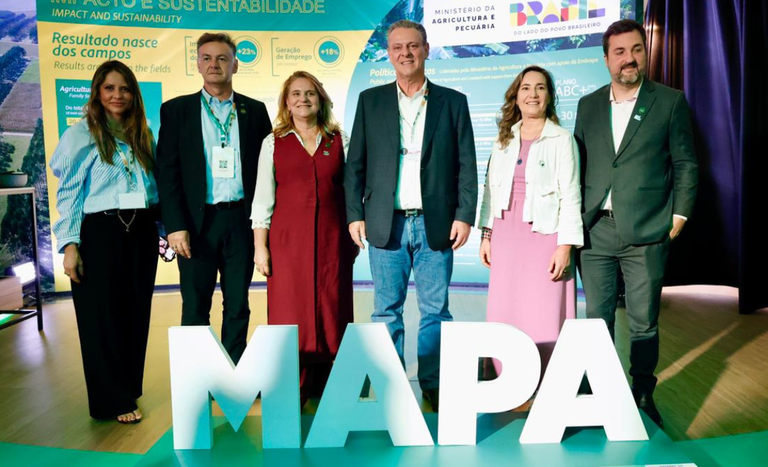
Minister Carlos Fávaro Visits AgriZone
Brazil’s Minister of Agriculture and Livestock, Carlos Fávaro, arrived on Monday (17) at AgriZone, the Sustainable Agriculture Hub at COP30 dedicated to climate-smart agricultural solutions. Throughout the week, the minister will maintain an office at the venue, where he will hold bilateral meetings and engage with international delegations, researchers, and representatives from the productive sector. The Ministry of Agriculture and Livestock (MAPA) is a partner in the initiative, hosted at Embrapa Eastern Amazon, which features technological showcases, panel discussions, demonstrations of production systems, and immersive experiences on sustainable land use in Brazil.
Received by Embrapa President Silvia Massruhá, the minister toured AgriZone’s central pavilion, where he spoke with journalists, greeted technical teams, and emphasized that the space represents a strategic collaboration rooted in science, technology, and public policy for sustainable agriculture. Fávaro noted that AgriZone reflects Brazil’s commitment to presenting production systems that align with environmental conservation. “This is an opportunity to show how science and technology have enabled Brazil to build a uniquely successful agricultural model,” he said.
Fávaro highlighted that Brazil continues to expand its global presence in food, fiber, and bio-based energy markets. “We are approaching 500 new market openings. This demonstrates the strength of Brazilian diplomacy under President Lula and creates real opportunities for our producers, even in a challenging global environment,” he declared.
The minister stressed that Brazil presents a production model based on the compatibility between agricultural growth and environmental protection. “There is no contradiction between producing and preserving. The climate works in favor of Brazilian agriculture, and AgriZone’s showcases make this clear.”
He also referenced federal government initiatives focused on restoring degraded land, emphasizing that Brazil can increase production without expanding into new areas. “Brazil does not need to advance into forested regions to continue growing. We have strong programs for restoring degraded areas and a legal framework that is enforced with strict responsibility.”
Linking AgriZone’s agenda to global climate finance, Fávaro added. “We are presenting forward-looking programs aimed at attracting international investment to restore degraded areas, support family farming, expand bioinputs, and modernize our agriculture. Embrapa is ideally positioned to expand research and share knowledge with the tropical world.”
When asked about the role of agriculture in climate negotiations, the minister was unequivocal. “Brazilian agriculture is not at COP seeking the spotlight. We are here to show the world the real model of our agricultural production and to dispel misconceptions. The vast majority of our producers follow good practices and act with environmental and social responsibility.”
Through the partnership between MAPA, Embrapa, and national and international institutions, AgriZone becomes a showcase for sustainable policies, technologies, and production systems. “This is a milestone. We are demonstrating Brazil’s productive system — and the direction in which we intend to advance,” Fávaro concluded.
Press Office
imprensa@agro.gov.br