Notícias
CAS
In Uruguay, Minister Fávaro highlights transparency and best practices in Brazilian agriculture
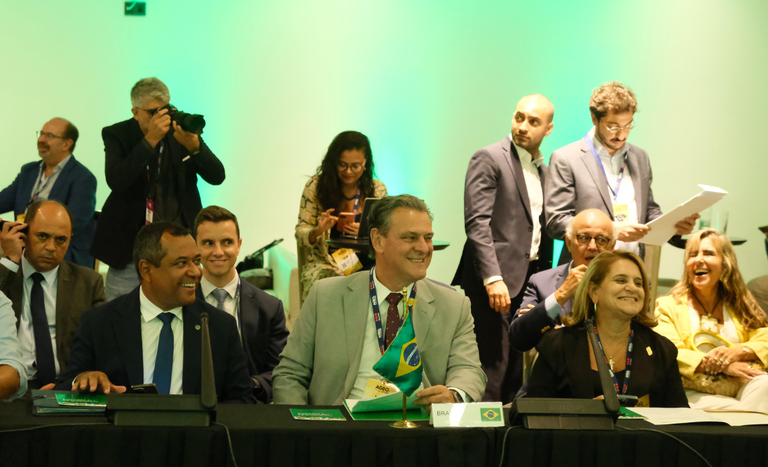
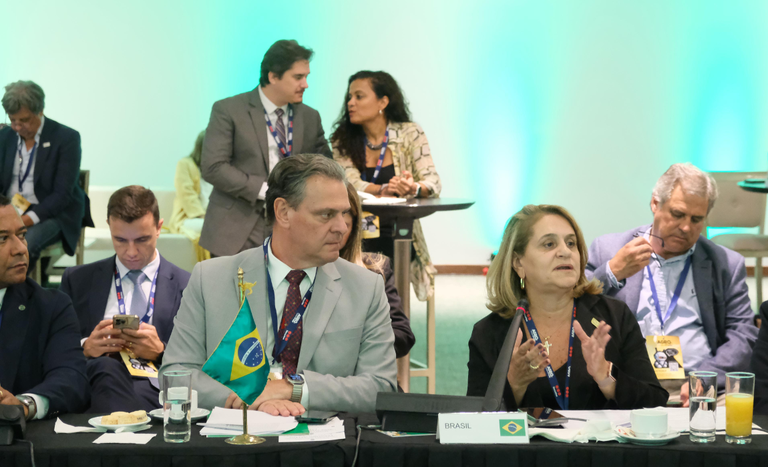
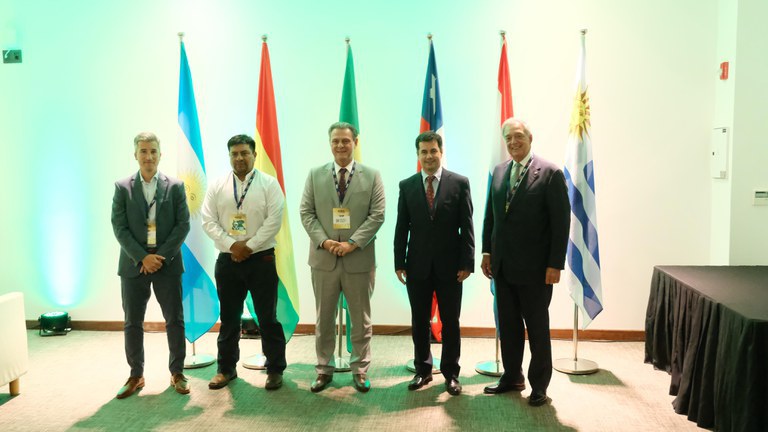
On Thursday (6), Brazil’s Minister of Agriculture and Livestock, Carlos Fávaro, joined ministers and secretaries from Argentina, Bolivia, Chile, Paraguay, and Uruguay for the 59th Ordinary Meeting of the Southern Agricultural Council (CAS) in Punta del Este, Uruguay.
Fávaro highlighted two key initiatives launched in December 2024: the National Plan for Individual Identification of Cattle and Buffaloes and the Agro Brazil + Sustainable Platform.
"This is an opportunity to showcase Brazilian legislation and the best practices of our producers. There is no better compliance model than this. However, we are making it clear that these are the parameters Brazil will follow in negotiations on the European Union's anti-deforestation legislation. We have our own laws and will ensure transparency in these best practices, but we will not go beyond what Brazilian law requires. Sovereignty comes first," Fávaro stated.
The Brazilian delegation from the Ministry of Agriculture and Livestock (Mapa) included Deputy Executive Secretary Cleber Soares, Secretary of Innovation, Sustainable Development, Irrigation, and Cooperativism Pedro Neto, Deputy Secretary Marcel Moreira, Head of the Special Advisory Office for Social Communication Carla Madeira, and Embrapa President Silvia Massruha.
The meeting started with a speech of Argentina’s Secretary of Agriculture, Livestock, and Fisheries and pro tempore CAS president, Sergio Iraeta, joining via videoconference along with Chile’s Minister of Agriculture, Esteban Valenzuela, and Paraguay’s Minister of Agriculture and Livestock, Carlos Díaz. Also present were Uruguay’s Minister of Agriculture, Livestock, and Fisheries and Bolivia’s Minister of Rural and Land Development, Juan Flores Lazo.
The first session focused on concluding the European Union-Mercosur agreement and Brazil’s request for international recognition as free of foot-and-mouth disease without vaccination, presented to the World Organisation for Animal Health (WOAH).
In the second session, strategies were discussed to mitigate the impact of environmental initiatives on trade, including the EU's provisional agreement on anti-deforestation regulations. Updates were also shared on the Working Group for Risk Management and Agricultural Insurance, where Brazil is represented by Mapa's Secretariat for Agricultural Policy. The final session addressed powdered milk imports, including Brazil's request for an anti-dumping investigation.
One major topic was agricultural insurance. Fávaro stressed the need to modernize, standardize, and expand access, even considering mandatory insurance for government-subsidized financing.
Agricultural insurance is crucial for Brazil. The 2025/26 Plano Safra (Harvest Plan) is being developed with major improvements in this area. Fávaro also emphasized the importance of technology, particularly weather stations from the National Institute of Meteorology (Inmet). He announced that Rio Grande do Sul will be the first state with full coverage by weather radar systems.
"With climate forecasting technologies, insurance policies can be tailored to producers' needs. CAS must prioritize this, and Brazil will always be a strong partner in advancing more efficient rural insurance," said the minister.
Another important topic highlighted was COP30 in Brazil. Mapa will provide technical support to the COP30 Presidency in defining the Agriculture and Food Systems Action Agenda. To coordinate efforts, the Ministry established the Executive Committee on Agriculture and Livestock. Fávaro invited CAS countries to participate in COP30.
"We will integrate agriculture directly into COP30 rather than having a separate space. We will present a unified position for South American agriculture regarding environmental issues to the world, not just the European community," Fávaro emphasized.
Embrapa President Silvia Massruhá announced the creation of the AgriBr space at Embrapa Amazônia Oriental, near the COP30 venue. This space will host immersive experiences, technology showcases, discussions, networking opportunities, and areas for partners and sponsors.
Another key discussion was the upcoming Inter-American Board of Agriculture meeting of the Inter-American Institute for Cooperation on Agriculture (IICA) in Brasília this November. "We have established working groups on various topics and made an important decision: endorsing Fernando Mattos, Uruguay's outgoing Agriculture Minister, as the next IICA president. Brazil fully supports his candidacy. Together, we aim to strengthen agriculture across South America, Central America, the Caribbean, and North America," said Fávaro.
About CAS
Established in 2003 through a Constitutive Agreement signed in Brasília, the Southern Agricultural Council (CAS) is a ministerial forum comprising the Agriculture Ministers of six South American countries. Its primary goal is to coordinate regional agricultural policies and define priority actions.
CAS works to establish common positions on key agricultural issues and implement cooperative policies to foster sector development in the region.
Its mission is to enhance integration and collaboration among member countries, ensuring sustainable agricultural development, food security, and competitiveness in South America.
Additional Events
During the official mission, presentations were made by the Federation of Rural Associations of Mercosur (Farm) and the Coordination of Family Farmers' Organizations of Mercosur (Coprofam). Additionally, a roundtable discussion took place with the Plant Health Committee (Cosave), the Permanent Veterinary Committee of Mercosur (CVP), and the Cooperative Program for Agrifood and Agroindustrial Technological Development of Mercosur (Procisur).
Press information
imprensa@agro.gov.br