Notícias
BRICS
BRICS Agriculture Working Group launches first meeting
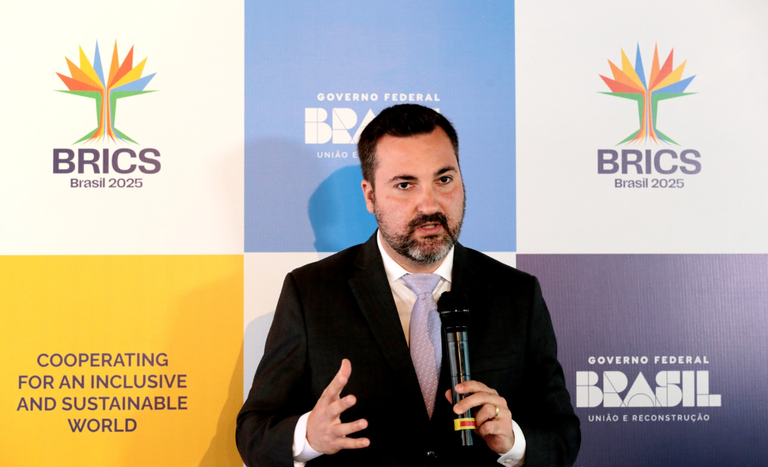

This week, the BRICS Agriculture Working Group (AWG) held its first meeting to address critical agricultural issues across member nations. The sessions, hosted on February 20 and 21, were led by Brazil’s Ministry of Agriculture and Livestock (Mapa), alongside representatives from the Ministry of Agrarian Development and Family Farming (MDA), the Ministry of Fisheries and Aquaculture (MPA), the Ministry of Foreign Affairs (MRE), and delegates from fellow BRICS countries.
A press briefing followed, led by Mr. Luís Rua, Mapa’s Secretary of Trade and International Relations, at the Federal Data Processing Service (Serpro) headquarters in Brasília, summarizing the discussions.
Secretary Rua highlighted Brazil’s global spotlight in 2025: “This is a landmark year. Beyond the BRICS Summit, we’ll host COP30, lead Mercosur, and convene agriculture ministers from Africa and the Inter-American Board It’s a moment of immense global representation.”
During the meeting, the AWG reviewed a draft document for the joint declaration at the BRICS Agriculture Ministers’ Meeting in April. Talks centered on tackling climate change, soil degradation, sustainable farming, trade growth, economic disparities, and food price swings.
Mr. Rua added, “We’ll also hold bilateral talks—a unique opportunity to address sanitary and phytosanitary issues and resolve matters that often take years to progress. With ministers and their representatives visiting Brazil, we aim to unlock critical topics for our export agenda and for countries seeking to export to us.”
BRICS accounts for 30% of the world’s farmland and leads global exports of meat, rice, soybeans, wheat, and corn. In 2024, Brazil’s agricultural exports reached US$165 billion, with 41% destined for BRICS nations.
Mr. Rua outlined AWG’s priorities: food security and nutrition, sustainable production, trade and infrastructure, and planned deliverables. Electronic certification emerged as a key focus, promising faster, safer product traceability.
Linked to COP30, the group will address pasture degradation, pushing initiatives like Brazil’s National Program for Converting Degraded Pastures into Sustainable Systems (PNCPD).
BRICS Agriculture Working Group overview
The AWG comprises experts from member countries, strategizing to tackle global agricultural challenges and enhance sectoral cooperation.
The group is shaping the 2025-2028 action plan, which will feature initiatives like aquatic food system enhancements, low-carbon farming innovations, land restoration, and bioinputs and bioenergy production.
Virtual conferences are slated for February 27-28 and March 6-7, with in-person talks on March 12-14 and April 14-15. A field visit and bilateral meetings hit Brasília on April 16, ahead of the Agriculture Ministers’ Meeting on April 17.
About BRICS
BRICS is an economic and political bloc comprising Brazil, Russia, India, China, South Africa, Indonesia, Egypt, Ethiopia, Iran, Saudi Arabia, and the United Arab Emirates. It fosters cooperation in trade, investment, sustainable development, food security, and poverty reduction.
The bloc represents 50% of the global population (around 4 billion people), 30% of extractive fishing, 70% of aquaculture output, and 80% of global food production by value. It includes over half of the world’s 550 million family farms and accounts for 25% of global GDP, with growing influence in international trade.
BRICS pushes for reforms in global financial institutions like the IMF and World Bank, advocating for greater representation of emerging economies.
The 2025 BRICS Summit in Brazil, themed “Cooperating for an Inclusive and Sustainable World,” will strengthen global agricultural collaboration, promote resilient food systems, and advance sustainable solutions benefiting millions, particularly in developing nations.
Press information
imprensa@agro.gov.br