
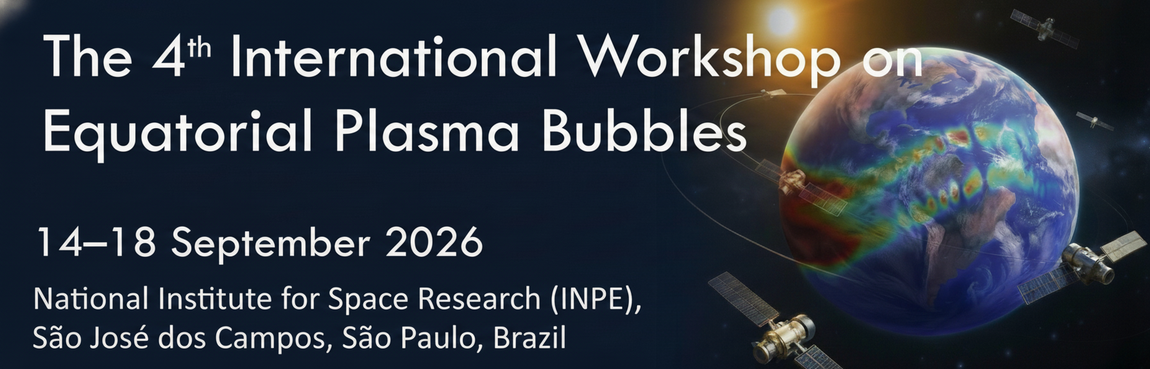
Welcome to EPB-4 – The 4th International Workshop on Equatorial Plasma Bubbles
Equatorial Plasma Bubbles (EPBs) are large-scale plasma density depletions that develop after sunset in the equatorial and low-latitude F-region ionosphere. These irregularities can severely disrupt trans-ionospheric radio wave propagation, resulting in GNSS positioning errors, interruptions in satellite-based communications, and increased risks for aviation, offshore operations, and space-based technologies. As society’s dependence on these systems continues to grow, advancing our ability to observe, understand, and forecast EPBs has become an urgent scientific and technological priority.
To address these challenges, the International Workshop on Equatorial Plasma Bubbles series was established. The first workshop took place at Nagoya University, Japan, in 2016 followed by the second at the Institute of Geology and Geophysics, Chinese Academy of Sciences (IGGCAS), Beijing, China, in 2019, and the third at the Indian Institute of Geomagnetism (IIG), Mumbai, in 2023. Each edition has provided a collaborative platform for leading experts to share advances in EPB observations, modeling, forecasting, and their societal implications.
The upcoming 4th International Workshop on Equatorial Plasma Bubbles (EPB-4) will be hosted by the National Institute for Space Research (INPE) in São José dos Campos, São Paulo, Brazil, from 14–18 September 2026. Building on the legacy of its predecessors, EPB-4 aims to push the frontiers of observational techniques, advance coupled atmosphere–ionosphere modeling and simulations, and employ artificial intelligence to deliver next-generation forecasts of EPBs.
EPB-4 Highlights
- Promote in-depth discussions on the latest observational techniques for monitoring Equatorial Plasma Bubbles (EPBs), including upcoming satellite missions, advanced ground-based sensors, and multi-instrument networks
- Highlight recent progress in coupled models and numerical simulations to advance the understanding of the mechanisms governing EPB seeding, growth, and variability
- Enhance forecasting capabilities by integrating artificial intelligence and machine learning with observational and modeling data
- Examine the societal and technological impacts of EPBs on GNSS positioning, satellite communications, and space weather services
- Foster international collaboration and stimulate new research initiatives dedicated to EPB science and its applications
Important Dates
- Abstract submission: from February 14 to June 19, 2026
- Abstract acceptance notification: June 29, 2026
- Registration: from July 6 to August 30, 2026
Mark your calendars: Brazil 2026!
Join the global community at EPB-4 and engage with leading experts addressing the latest challenges in space weather and ionospheric science. Let’s exchange insights, strengthen collaborations, and push the frontiers of research — together in Brazil.
Contact Information
We are available to provide detailed information regarding registration, abstract submissions, the scientific program, and all other matters related to EPB-4.
Please contact Dr. Diego Barros (INPE) at diego.barros@inpe.br
We look forward to welcoming you to EPB-4 in Brazil!
Support
| ||
|  |
|



Sponsors
 |  |  |  |  |