Value Chain
The Value Chain is a graphical representation of the processes that generate value for society. It describes the value created by the organisation’s set of high-level processes. In addition, it seeks to address problems and meet the needs of beneficiaries.
This instrument is essential to Process Management at ANEEL, as it guides the structure of processes, linking them to the activities that must be carried out and the results that must be achieved. It is also aligned with the Agency’s Strategic Planning.
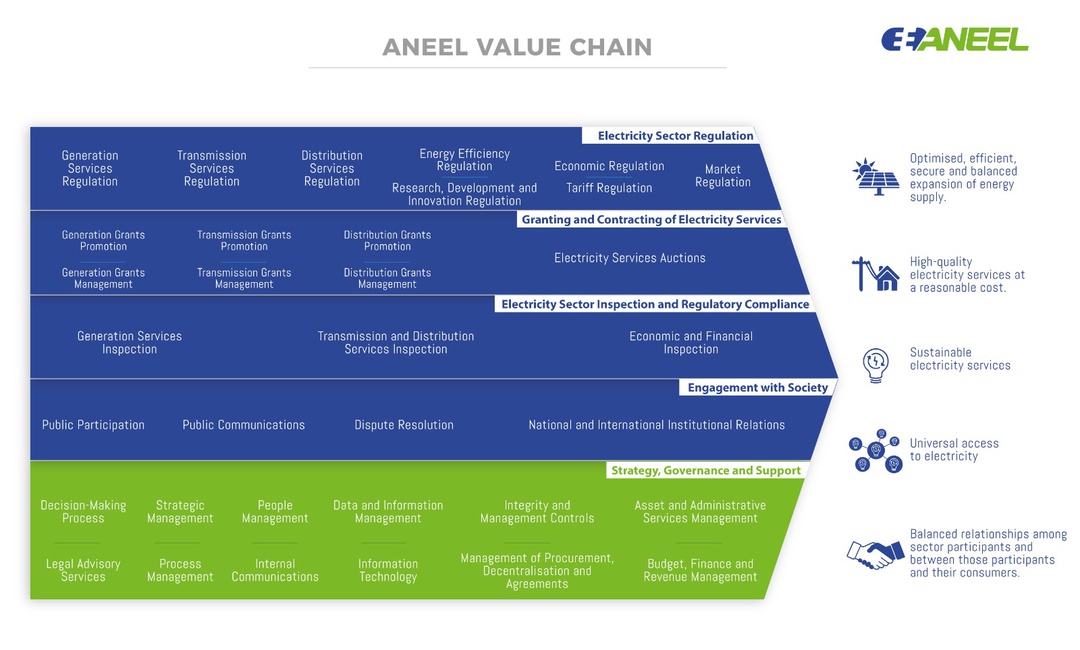
- Value Chain
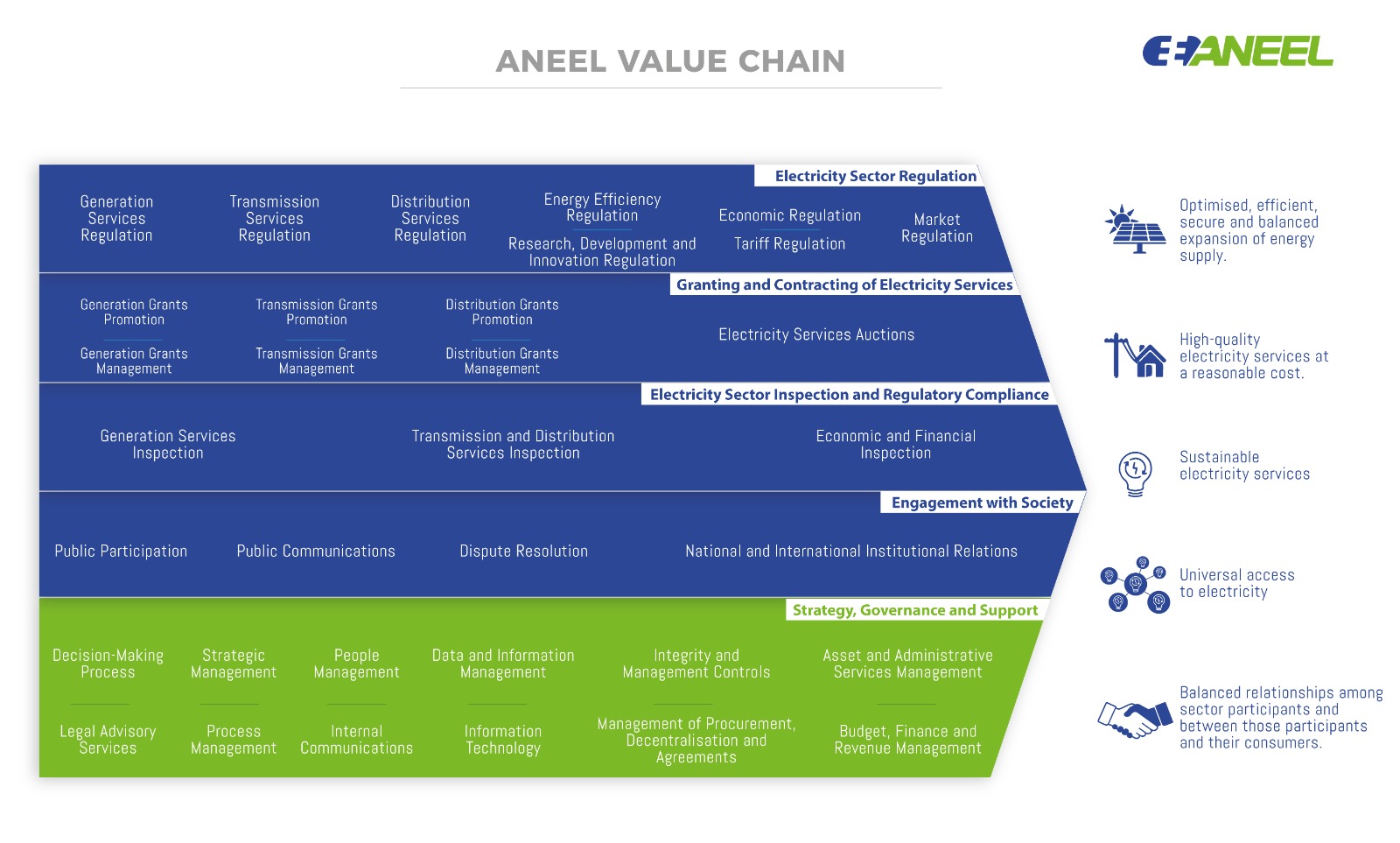
The ANEEL Value Chain, revised in 2022, comprises thirty-four operational management processes, distributed across the following macroprocesses.
Electricity sector regulation macroprocess
This macroprocess encompasses the development of regulatory interventions based on current public policies and legal provisions, guided by the principles of quality, technical excellence, simplification, transparency, timeliness, predictability, regulatory impact assessment, public participation, efficiency, and innovation, addressing matters aimed at ensuring the proper functioning of the electricity sector, including technical, economic, tariff-related, and market aspects.
It comprises eight operational management processes associated with the regulation of:
- Generation Services;
- Transmission Services;
- Distribution Services;
- Energy Efficiency;
- Research, Development, and Innovation;
- Economic Issues;
- Affordable tariffs; and
- Electricity Market.
Electricity Service Granting and Procurement Macroprocess
This macroprocess contributes to enhancing security of supply, universal access to public electricity services, and tariff affordability through the management of generation, transmission, and distribution concession contracts, distribution permit contracts, and generation and transmission authorizations.
Its purpose is to ensure the expansion of electricity supply and of the transmission infrastructure of both the National Interconnected System (SIN) and Isolated Systems (SI), as provided for in sectoral plans and in the acts issued by the granting authority.
It comprises seven operational management processes:
- Promotion of Generation Grants;
- Management of Generation Grants;
- Promotion of Transmission Grants;
- Management of Transmission Grants;
- Promotion of Distribution Grants;
- Management of Distribution Grants; and
- Electricity Service Auctions.
Electricity Sector Regulatory Oversight and Compliance Macroprocess
This macroprocess aims to oversee regulated entities through a preventive and evidence-based approach, with a view to promoting regulatory compliance.
It comprises three operational management processes:
- Generation Services Oversight;
- Transmission and Distribution Services Oversight; and
- Economic and Financial Oversight.
Relations with Society Macroprocess
This macroprocess seeks to ensure that society contributes to ANEEL's decision-making process and remains informed and engaged regarding the Agency's activities and regulatory actions. It also aims to resolve disputes between electricity sector agents and between consumers and those agents, while maintaining relationships with stakeholders at both national and international levels in order to safeguard the Agency's institutional interests for the benefit of society.
It comprises four operational management processes:
- Public Participation;
- Social Communications;
- Conflict Resolution; and
- National and International Institutional Relations.
Strategy, Governance, and Support Macroprocess
This macroprocess provides direction and support to all organizational units so that they can implement and deliver their processes effectively, promoting strategy, governance, the necessary resources, and the final decision-making processes related to the electricity sector.
It comprises twelve operational management processes:
- Decision-Making Process;
- Strategic Management;
- Process Management;
- People Management;
- Procurement, Decentralization, and Agreements Management;
- Budget, Finance, and Revenue Management;
- Asset and Administrative Services Management;
- Data and Information Management;
- Information Technology;
- Integrity and Management Controls;
- Legal Advisory Services; and
- Internal Communications.