Loading
Delegates' Area
English
RESEARCH AND INNOVATION
Research and Innovation WG promotes an international seminar on tropical forests: Amazonia as the main focus and theme of debates
The International Seminar on the Amazon and Tropical Forests began this Tuesday (17th). This event is part of the G20 Research and Innovation Working Group's agenda in Manaus, the capital of Amazonas. In partnership with other organizations, the Brazilian Ministry of Science, Technology, and Innovation discusses the present and future of the forests that regulate the global climate.
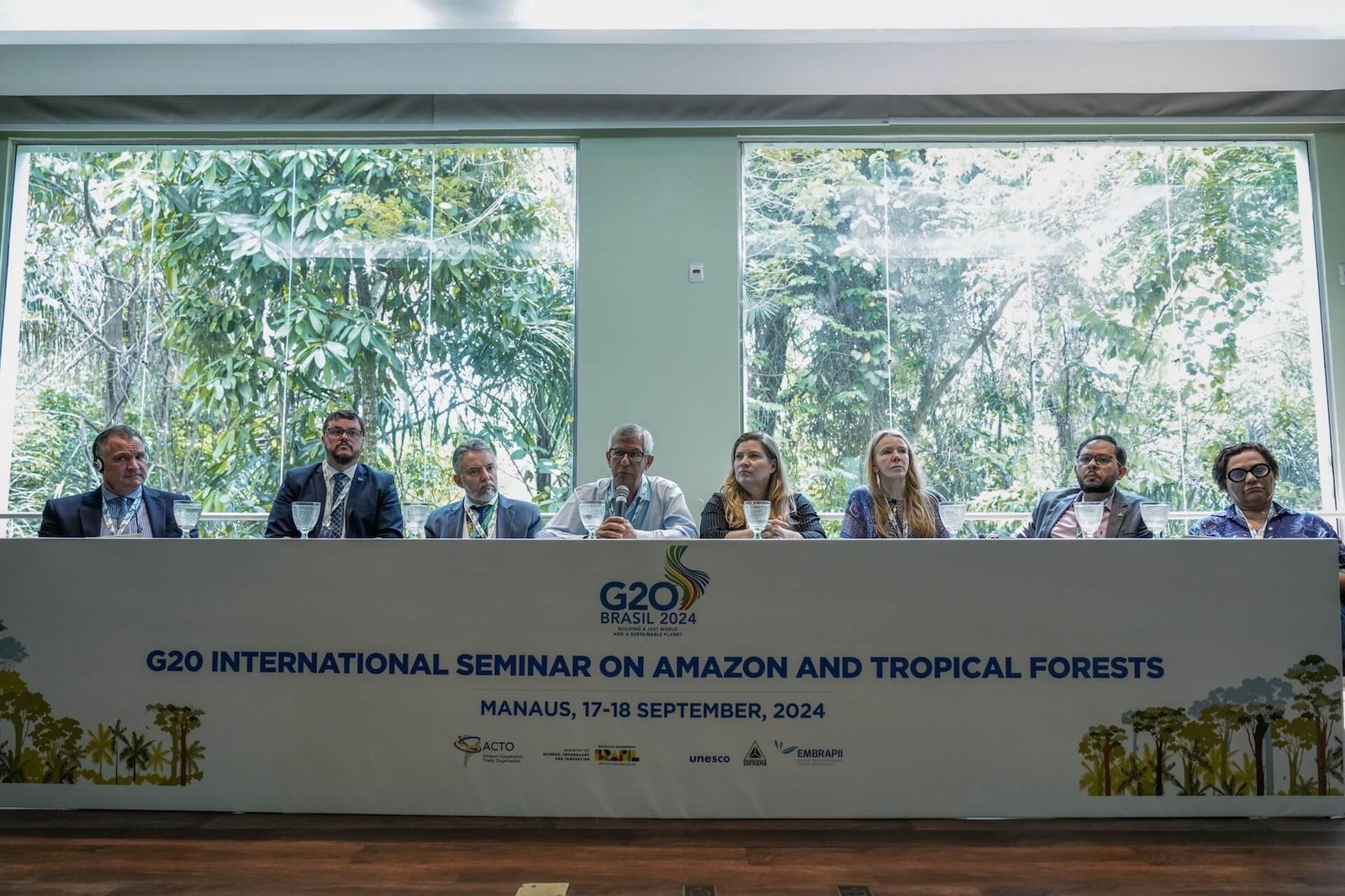
The importance of tropical forests in minimizing the impacts caused by climate change is no longer a recent debate. But how do these forests, even if they reach zero deforestation, suffer from the climate crisis? This is one of the main topics under discussion at the International Seminar on the Amazon and Tropical Forests, a side event of the G20 Research and Innovation Working Group (WG) that began on September 17, in Manaus, in the heart of the Amazon.
The debates, which explore issues such as decarbonization, traditional knowledge, and tackling inequalities in science, biological diversity, open innovation, and bioeconomy, take place on September 18th at the Brazilian National Institute for Amazonian Research (INPA), in a scenario that illustrates, through the fauna and flora surrounding the auditorium, the urgent and undeniable challenges faced by the forests and the world. This is because these forests are responsible for regulating the global climate. Beyond Brasil, more than sixty countries worldwide also have tropical forests in their geography.
"How will climate change influence biodiversity? How can we achieve sustainable development while also ensuring inclusive development? We cannot forget that millions of people live in the Amazonia and need access to civilization's resources. In other words, we need to advocate for a new model of development, and when we are faced with these significant issues, we do not doubt proposing this Seminar," said Osvaldo Moraes, director of the Department for Climate and Sustainability at the Ministry of Science, Technology, and Innovation (MCTI), which coordinates the work of the WG during the Brazilian presidency.
At the opening table, topics such as the role of forests from a human perspective, towards a more equitable world; the value of science for advancements in environmental protection; and the imperative of discussions leading to tangible applications were raised. The need to strengthen collaborations among governments, civil society organizations, and businesses to achieve immediate as well as medium- and long-term goals was also addressed by the panelists.
Amazonia: the main focus and the object of debates
"We need to change both our approach and production processes, as they continue to drastically impact our environment. We have reached a point where this is no longer questioned, where there is no doubt from a scientific standpoint about the need to address environmental issues and sustainable development in any sector. It is the impact of human actions, especially productive ones, which has led to the visible results we now see in Brasil," said Vanessa Grazziotin, Executive Director of the Amazon Cooperation Treaty Organization (OTCA).
"The country and the Amazon, in particular, have been experiencing extreme drought for the second consecutive year, the first time in history, which not only brings problems to the environment but also leads to hunger and a lack of access to clean water for many communities living in the region that holds the largest surface water reserve on the planet. It's unbelievable,” added Grazziotin, which further emphasized the necessity of understanding borders as human delineations of countries and not as a condition of the forest, which is unique.
Since 1995, the ACTO, formed by eight Amazonian countries (Bolivia, Brasil, Colombia, Ecuador, Guyana, Peru, Suriname, and Venezuela), has been the only socio-environmental bloc in Latin America. Seven of the eight countries in dialogue with the G20 have delegations involved in the Seminar, deepening connections with other international representations.
The Seminar is an organization from the Ministry of Science and Technology of Brasil in partnership with the Amazon Cooperation Treaty Organization (ACTO), the United Nations Educational, Scientific and Cultural Organization (UNESCO), the Superintendence of the Manaus Free Trade Zone (SUFRAMA), and the Brazilian Company of Research and Industrial Innovation (EMBRAPII).