Loading
Delegates' Area
English
GLOBAL ALLIANCE
G20 debates public policies to combat hunger with a focus on female empowerment
A meeting held in parallel to the G20 Ministerial Meeting gathered female experts and leaders to debate the importance of public policies focused on vulnerable women. Brasil’s First Lady Janja da Silva emphasized the need for programs such as Bolsa Família and School Meals. Gender caregiving initiatives, such as communal kitchens in the peripheries and biogas production from biodigesters, will be presented at the G20.
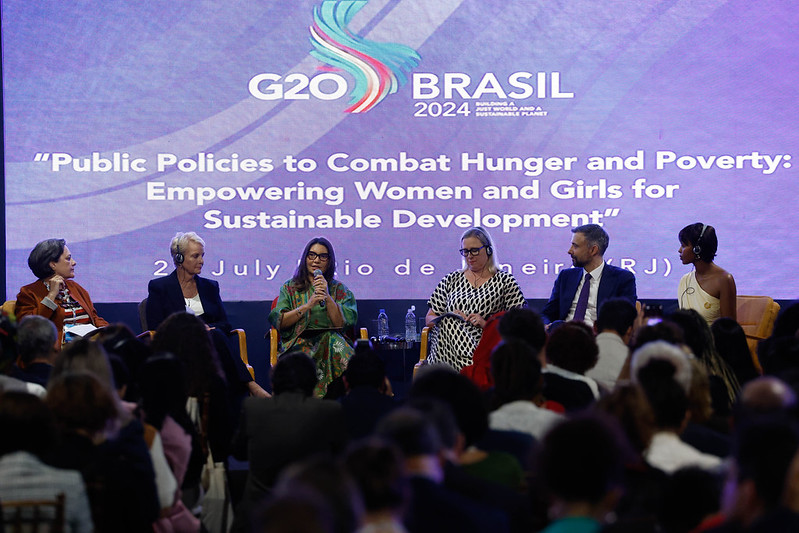
In an event held in parallel to the Ministerial Meeting of the G20 Task Force for the creation of a Global Alliance against Hunger and Poverty, the Brazilian Government, in partnership with NGO Global Citizen, gathered specialists to discuss “Public Policies for Combating Hunger and Poverty: Empowering Women and Girls for Sustainable Development”
The event was held at Galpão da Cidadania, in Rio de Janeiro, and featured the presence of guests, including Brasil’s First Lady, sociologist Janja Lula da Silva; the European Commissioner for International Partnerships, Jutta Urpilainen; the Executive Director of the World Food Programme, Cindy McCain; the President of the National Council on Food Security and Nutrition (Consea), Elisabetta Recine; and the President of the International Fund for Agricultural Development (IFAD), Alvaro Lario. The session was moderated by Sabrina Dhowre Elba, activist and UN Goodwill Ambassador to IFAD.
During the panel, participants highlighted the importance of public policies that consider the specific needs of women and girls in vulnerable situations. They also discussed the central role of female leaders in the creation and implementation of these policies and emphasized the need for initiatives that prioritize both financing and technical cooperation to generate proven results.
Janja da Silva underscored Brasil’s proposal to create a Global Alliance against Hunger and Poverty. The Alliance will be structured around three pillars: national, financial, and knowledge, seeking to facilitate the implementation of policies adjusted to the needs of each country. With an approach based on conditional income transfer, social protection, school meals, and family farming, the Global Alliance aims to combat all forms of malnutrition and poverty, promoting inclusive and sustainable development.
According to the sociologist, the Global Alliance will function as a framework for public policies worldwide, providing knowledge and technologies for successful policies. She highlighted Bolsa Família, a Brazilian Government program, as a major income distribution initiative, and mentioned the School Meals Program as essential for removing Brasil from the hunger map. “These policies are part of the pool of public policies that Brasil will present to other countries within the Global Alliance,” she declared.
Janja announced that in October, at the G20 Working Group on Energy Transition meeting in Foz do Iguaçu, the government will present Brasil’s experiences with gender caregiving issues, including the creation of communal kitchens in peripheries and a gas production program using biodigesters, a social technology that could benefit families in both peripheral and rural communities with systems that convert organic waste, such as animal waste, into biogas. “We want this experience to be included into the Global Alliance’s policy pool. Women in various regions will no longer need to seek firewood, or expose themselves to the risk of burns from cooking with firewood,” she said.
Jutta Urpilainen, the European Commissioner for International Partnerships, highlighted that women and girls are among those most affected by extreme poverty, with 314 million at risk of falling below the poverty line.
Cindy McCain, Executive Director of the World Food Programme (WFP), stated that the Global Alliance will drive new efforts and emphasized the importance of school meals for local communities.
Elisabetta Recine, President of the National Council of Food Security and Nutrition (Consea), underscored that strengthening democracy is crucial for combating hunger and poverty. She explained that poverty is not homogeneous, and cited the Food Acquisition Program (PAA) as an example that originated from communities and popular movements, highlighting the importance of engaging with civil society.
Alvaro Lario, President of the International Fund for Agriculture Development (IFAD), highlighted the necessity of programs aligned with principles for combating hunger and poverty. He noted that improving income is important, but empowerment programs are also relevant. He concluded by noting that in agriculture, women represent around 15% of landholders in Brasil, and this inequality in access to land prevents many from achieving financial autonomy. Without the right to use and control land, they remain dependent on landowners, which compromises their economic and social development.