G20 attentive to the appreciation of education establishes several partnerships with Brazilian public federal universities
G20 forms partership with Federal Universities to translate journalistic content into English and Spanish. The students celebrate the opportunity to practice what they learn at university, while the professors believe it is a unique opportunity to unite knowledge, journalism, and dissemination between different cultures.
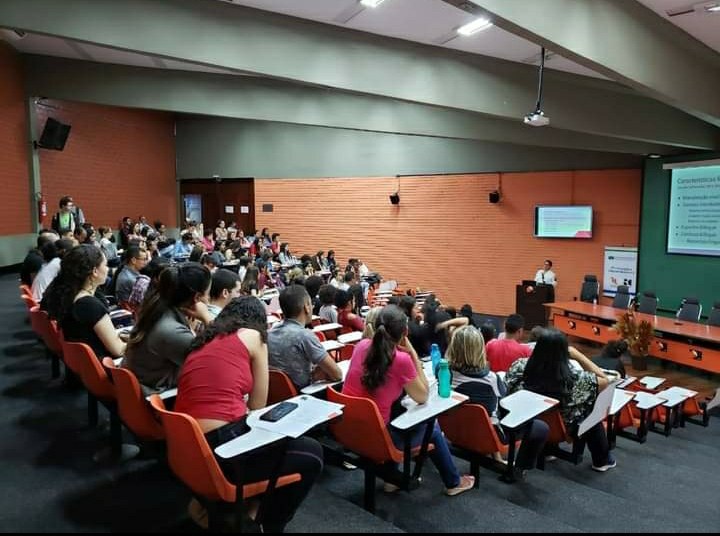
The G20 brings together the world's leading economies, making the summit a major international event. Therefore, to communicate with the most significant number of people on all continents, the journalistic articles on the G20 website and the radio bulletins have versions in English and Spanish. To help with the daily translation tasks, G20 Communications has established a partnership with the Federal University of Santa Catarina (UFSC) for translations into English and Spanish and with the University of Brasília (UnB) to translate informative content from Portuguese into Spanish.
According to Andréia Guerini, coordinator of the Graduate Program in Translation Studies (PGET, its acronym in Portuguese) at the Federal University of Santa Catarina (UFSC), the course is a reference for national and international translation and interpreting studies. The Secretariat of Social Communication of the Presidency of the Republic (Secom) sought the university in order to dialogue with qualified professionals from public universities to develop an agreement. After internal processing at Secom and in educational institutions, the partnership must be an extension project in which the participating students will be remunerated through extension scholarships. For Andréia, “the project contributes to the international dissemination of strategic information and aligns with the university's core values of commitment to academic excellence and innovation. In addition to promoting knowledge and understanding between different cultures”.
Professor of the degree in Languages - Spanish Translation from the Federal University fóf Brasília (UnB), Magali Pedro agrees that the partnership not only helps in disseminating G20 information but is also a combination of opportunities and strategic alignments that allows UnB to contribute directly to the success of Brazilian leadership in the G20. “The importance of this partnership is enormous because it represents a unique opportunity to involve our students in a project of great international relevance, allowing them to put into practice what they learn in the classroom. It offers a valuable experience far beyond the academic environment”, celebrates the professor. In the case of UnB, the agreement between Secom and the university, through a support foundation, will provide internship scholarships for students involved in the work.
Douglas Martins, a student at Letras Tradução Espanhol at Universidade de Brasília (UnB), emphasizes that university extension means taking academia outside the walls of the university and helping society with its needs. He mentions Darcy Ribeiro, one of the founders of UnB, to advocate for the need to be aware of society's most immediate demands, not only scientific research. "The G20 articulates essential issues for the global future, and Federal Public Universities could not be left out of this. Thus, both sides can only win, both G20 Communication and ours, because they understand the social and formative importance of the university, "says Douglas, who will be one of the translators in the project.
The PhD student in translation at the Graduate Program in Translation Studies at the Federal University of Santa Catarina Tuan Peres believes that "this partnership is productive because it allows practicing the reflections developed in the preparation of this work and provides a translation team committed to public initiatives in Brasil, which is only the first of many other upcoming partnerships." Tuan will contribute to English translations.
Partnerships with Public Universities
The G20 Communication had already established a partnership with Public Universities in the country, such as the Federal University of Grande Dourados (UFGD) in Mato Grosso do Sul, to translate journalistic content into the Guarani language. In addition to the contribution of professor and indigenist Paulo Humberto Borges from the Western Paraná State University (Unioeste), who through cooperation between Itaipu Binacional and the Lutheran Foundation of Diakonia (acronym Fundação Luterana de Diaconia), made it possible to translate radio bulletins into the Guarani-Nhandewa language. The professor was responsible for the intermediation between organizations and indigenous communities in Paraná.
According to Paulo Humberto, journalistic information in an indigenous language gives visibility to communities and manages to oppose prejudice, albeit minimally. In addition to being an unprecedented initiative within the G20 for not only using the hegemonic languages. He also points out that Brasil has more than 170 living Indigenous languages today, and it is essential to rescue and value this part of the country's identity. “The G20, under the Brazilian presidency, together with Itaipu, is establishing this seemingly simple partnership here, but it presents a great result in the perspective of rescuing identity and valuing these languages, as well as advocating for a vigorous fight against all forms of prejudice and misinformation,” he said.
Micael Eliabe Severino, in the Guarani-Nhandewa language Awa Gwyrapadju, is one of the voices of the G20 news that reaches the community's homes through the National Radio Network. The communicator lives in the Indigenous village of Laranjinhas, in Paraná (PR), and says that the work came at a good time because it helped him learn more about his people's language. For a long time, the language was not spoken in the family due to a fear of prejudice. “I follow the professors when they translate, and I learn new words that I don’t know. When it’s time to record, I practice speaking. I feel that this partnership with the G20 is very important for us because it will open doors for us, bring us supporters, and launch us to the world, "says Micael, happy with his participation.
The young man hopes that the Indigenous collective Djagwa Etxa will gain more visibility and supporters for its daily fight to end prejudice against Indigenous peoples in Brazil and worldwide.