Loading
Delegates' Area
English
FINANCE TRACK
Duty fulfilled: Finance Track closes debates at the G20 Brasil
In a final document, member countries reinforce the need for new financial mechanisms to face future crises, with a particular focus on low-income countries and climate change.
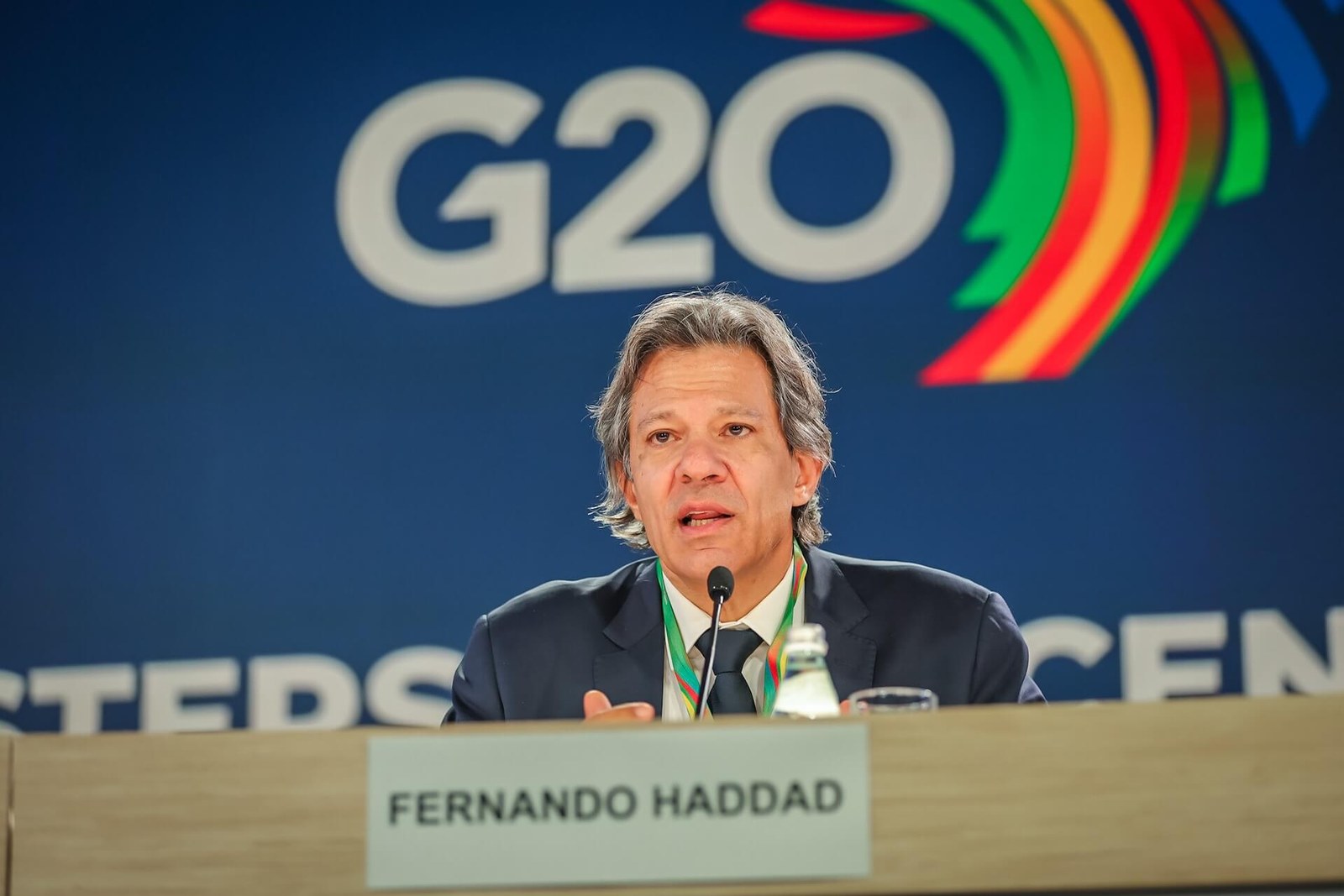
“In a way, the financial track fulfilled its mission.” With this sentence, Fernando Haddad, Brasil's Minister of Finance, summarized the feeling of duty fulfilled during the press conference of the 4th Finance Ministers and Central Bank Governors Meeting this Thursday, October 2024, in Washington (USA). Haddad highlighted the group's central role in discussing the recent global crises and building a robust reform agenda that will define the future of the planet's largest economies.
"Brasil is very pleased with the results of the two communiqués approved by consensus, as usual, which reflect our intentions announced at the end of 2023, when we assumed the presidency of the group," said the Brazilian minister who coordinates the Forum's Finance Track and the Central Bank of Brasil (BCB). The closing of the Track is one of Brasil's last commitments as part of the G20 presidency before the presidential summit, which will be held in November in Rio de Janeiro.
Haddad, alongside the president of the BCB, Roberto Campos Neto; Tatiana Rosito, the secretary of International Affairs of the Ministry of Finance, and the director of International Affairs of the Central Bank, Paulo Picchetti, made a positive assessment of the advances made and made it clear that the future will bring new challenges. “Today, during the ministerial meeting, we were all very comfortable with the fact that, in a way, the financial track fulfilled its mission to work with all 27 of these countries, overcoming the 2008 crisis and the pandemic,” he said.
Consensus in the G20 Brasil
The statement of this last meeting of ministers and central bank presidents shows how Brasil, as president of the group, assisted in the mediation that culminated in important advances in the main global economic agendas. The document points to the consensus among the G20 countries on the need to strengthen the fight against inequality and climate change, recognizing that the “cost of inaction is greater than the cost of action, both in economic and distributional terms.” In addition, Brasil helped advance the debate on the reformulation of Multilateral Development Banks (MDBs), ensuring that they are better prepared to face global challenges, especially in low- and middle-income countries.
Another significant advance in the communiqué was the promotion of more robust international cooperation in the tax area. In line with the historic Rio de Janeiro Declaration on International Tax Cooperation, this latest communiqué provides for greater cooperation between countries to ensure that “very high net worth individuals are effectively taxed,” an agenda presented by Brasil as a priority to reduce inequalities and a central point for inclusive economic growth.
Brasil's presidency also excelled in supporting countries in situations of financial vulnerability. Leading discussions on coordinated solutions to sovereign indebtedness and transparency in debt management, Brasil reaffirmed its commitment to promoting global financial stability, focusing on the most fragile economies.
“Although we have achieved several advances in important discussions, there are still obstacles ahead,” said the minister. “These challenges, which have somehow been overcome, will still be present in the future and can be just as challenging as the latest ones,” he said. For Haddad, the global economy needs to be prepared to deal with crises that can still test countries' responsiveness, and the G20 remains the centerpiece for coordinating actions to mitigate these crises. "There is a very extensive reform agenda that involves not only the G20, but also the OECD and the UN system, in order to seek instruments to bring balance," he said.
According to Haddad, new financial mechanisms are needed for low-income countries, especially those in debt. “Today's communiqué was also a consensus. All multilateral development banks have aligned around a common agenda to be able to become better, bigger, and more effective in addressing these challenges, especially considering low-income and low-income indebted countries, "he said.
The minister stressed that the impact of climate change on the poorest countries is one of the most urgent issues and warned that Brasil had worked intensively to ensure that these countries have access to financial instruments capable of helping them face the climate crisis without compromising their economic development. “We know now that climate change will clearly impact the poorest countries,” he said.
South Africa
With the G20 presidency about to be transferred to South Africa, Haddad demonstrated confidence in the group's future and highlighted the alignment between the two countries. According to the minister, South African priorities align with what Brasil left as a legacy to the G20. "None of the topics that are dear to Brasil will be left out of this agenda and, of course, they will present new problems and solutions, but I believe that the Brazilian agenda will be preserved and perhaps even deepened, as expected," he explained.
For example, the Brazilian proposal on the taxation of large fortunes will be incorporated by South Africans. “The presidency of a different country will not change the implementation of this measure. We have been dealing with pillars one and two [of the OECD] for years, and if we want more effective responses to global problems, it is crucial to accelerate implementation, as advocated by several countries,” he said.
From the Ministry of Finance of Brasil
Translated by PGET-UFSC