Loading
Delegates' Area
English
G20 SOCIAL
Consea discusses hunger eradication and global governance reform
The National Council for Food and Nutrition Security promotes a debate on strategies for the eradication of hunger and the need for reforms in global governance at a G20 Social seminar, bringing together leaders from governments, civil society and international organizations in Rio de Janeiro.
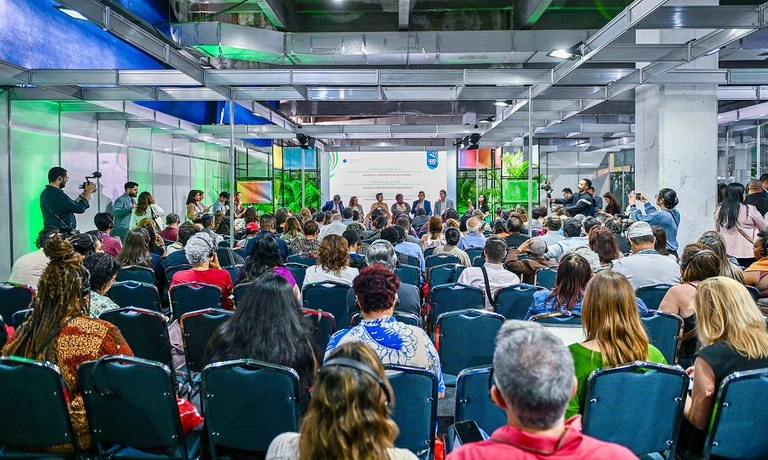
As part of the G20 Social Summit programme, the International Seminar, "The Eradication of Hunger and Global Governance Reform: Necessary Dialogues and Convergences," facilitated an unprecedented dialogue among key actors from governments, civil society, and international organizations. These participants contributed to various processes led by the Brazilian presidency, focusing on combating hunger and reforming global governance within the framework of the G20.
Carried out by the National Council for Food and Nutrition Security (Consea), the self-managed activity was supported by the German Ministry of Food and Agriculture, the Institute of Socioeconomic Studies (Inesc) and the Ibirapitanga Institute, and was part of the program of the G20 Social on November 14 in Rio de Janeiro.
First Lady Janja Lula da Silva congratulated Consea for the initiative and said that the holding of the G20 Social is one of the most important moments in President Lula's administration. Janja recalled that Brasil has returned to the hunger map, due to the setbacks of previous governments, but that Lula's current term is committed worldwide to the 2030 agenda for the eradication of hunger, poverty and also the fight against inequality.
“After so many years of investment and work, unfortunately poverty has returned to be a sad reality for the Brazilian people and the setback of rights in previous governments were the key to this. In the world, the climate crisis and wars impact the production of inputs and food. People live without knowing what the next meal in the world will be. That is why we are gathered here, as we want to take responsibility and not just sign agreements. A global call for urgent and ambitious action. With political determination, we will be able to move forward,” she said.
According to the Minister of State for Human Rights and Citizenship, Macaé Evaristo, the innovation of social participation within the G20 framework not only facilitates an unprecedented dialogue between governments and societies from different regions of the world but also represents a milestone in the evolutionary process of humanity.
“When our president puts the eradication of hunger as the key, it is so that we can reduce the inequality among us. So we can see people in the same way. We need to undergo a structural and radical change to ensure the right to land and humanity wherever we are in the world because dignity and citizenship belong to everyone, everywhere on the planet.
For the Minister of the General Secretariat of the Presidency of the Republic, Márcio Macedo, the seminar is the concretization of strategies for advancing the formal and material commitment of the G20 and Brasil in the fight against hunger and poverty. And, according to him, Consea is the main actor in the debate on food and nutritional security in the country.
"Putting the fight against hunger, the fight against poverty and inequalities as central themes of the G20 is something totally unprecedented. And bringing the participation of social actors to this debate, as is the case with this Consea event at our G20 Social, is courageous and necessary for global governance. A transformative action that we are learning and doing. An audacity, a necessity of this historical moment, and essential to place the people's protagonism, our mark, at the center of the decisions made by great leaders."
Regarding Consea's participation in the G20 Social, President Elisabetta Recine explained that the main objective of the Council's self-managed activity in the G20 Social is to point out participatory paths of governance for food systems, thus contributing to the guarantee of the Human Right to Adequate Food and to overcome inequalities.
"There is no point in just signing agreements. They need to be fulfilled. That's why we're here! To bring the guarantee of the Human Right to Adequate Food to the agenda of the global alliance.”
Alexander Rose, representative of the German Ministry of Food and Agriculture, also attended the event and ratified his country's support in the fight for food and nutritional security. He recalled that Germany has already gone through extreme hunger scenarios and that they are willing to help the world in fulfilling the human right to adequate food.
The Minister of Social Development and Assistance, Family, and Fight Against Hunger, Wellington Dias, highlighted the priority given to global governance reform in President Lula's administration and the Brazilian government's commitment to launching the Global Alliance Against Hunger and Poverty. He also took the opportunity to thank Germany for joining the Global Alliance and called on other countries to participate in the initiative.
G20 Social
The event began this Thursday, November 14, with a marathon of self-managed activities organized by social movements from different countries. Check out the schedule HERE. Throughout the meeting, 180 stalls set up in the G20 Social Territory will offer everything from handmade products to specialized publications.
The morning of the second day, November 15, will be dedicated to three simultaneous plenary sessions. From 9 am to 12 pm, the central themes of the meeting will be addressed: tackling hunger and inequalities, the urgency of climate change with a just transition, and the necessary global governance reform.
The decisive moment takes place on the morning of the 16th, when the Kobra Space hosts the Final Plenary, starting at 9 am. At this meeting, the document will be consolidated with proposals built over the three days of debates, which will be submitted to the authorities during the closing act, scheduled for 11 am. After the event, there will be an afternoon of cultural activities and rounds of talks in the G20 Social Territory.
Global Festival Alliance
Between November 14 and 16, Rio de Janeiro will be the stage for a great cultural action to fight hunger and poverty. The Global Alliance Festival will be held in Praça Mauá, with free admission, and will bring together important Brazilian artists to promote engagement and discussion about the main distinguishing feature of Brasil's G20 presidency, the Global Alliance Against Hunger and Poverty.
Article produced by the General Secretariat of the Presidency of the Republic.
*Translated by PGET-UFSC