Loading
Delegates' Area
English
PARTNERSHIP
A fair energy transition: Petrobras releases an open data page with a ranking of greenhouse gas emissions among G-20 countries
The company has launched a tool that analyzes greenhouse gas emissions by G20 countries and presented the first results of its program that creates jobs for black and brown individuals, women with children, and disabled people.
Petrobras has launched a tool with interactive graphs about the evolution of energy consumption and greenhouse gas emissions by G20 countries. The tool provides an open data page for analyzing the progress of the world's top economies toward a fair and inclusive energy transition in line with the Paris Agreement goals, which can be viewed at https://petrobras.com.br/sustentabilidade/dados-abertos.
On this page, it is possible to check out the ranking of GHG emissions, global emissions per sector or GHG, emissions per economic sector, and energy and emission flow.
The release occurred this Thursday (11/14) live at Espaço CRIA with Petrobras's Climate Officer, Viviana Canhão Bernardes Gonçalves Coelho. She discussed the results, challenges, and opportunities of a fair energy transition focused on Petrobras initiatives, also mentioning Brazil's role in this scenario.
Among the main points, she pointed out Petrobras's 40% reduction in emissions, including the company's investments and efforts to expand the use of clean energies in Brazil, increasing fourfold the company's biofuel production, boosting renewable electricity generation, studies into other renewable sources, and CCUS.
"Petrobras has been implementing and developing hundreds of decarbonization opportunities. The result of the 40% reduction is equivalent to three times that of all Brazilian aviation, which is very significant. We are also expanding our investments in renewable sources, seeking a spike in biofuel and renewable electron production. We are helping to create a society with reduced emissions, safeguarded ecosystems, and quality energy that is accessible to all," said Viviana.
Jobs for black and brown individuals, women with children, and disabled people: The Petrobras Autonomy and Income Program will create 11 thousand openings in 2025
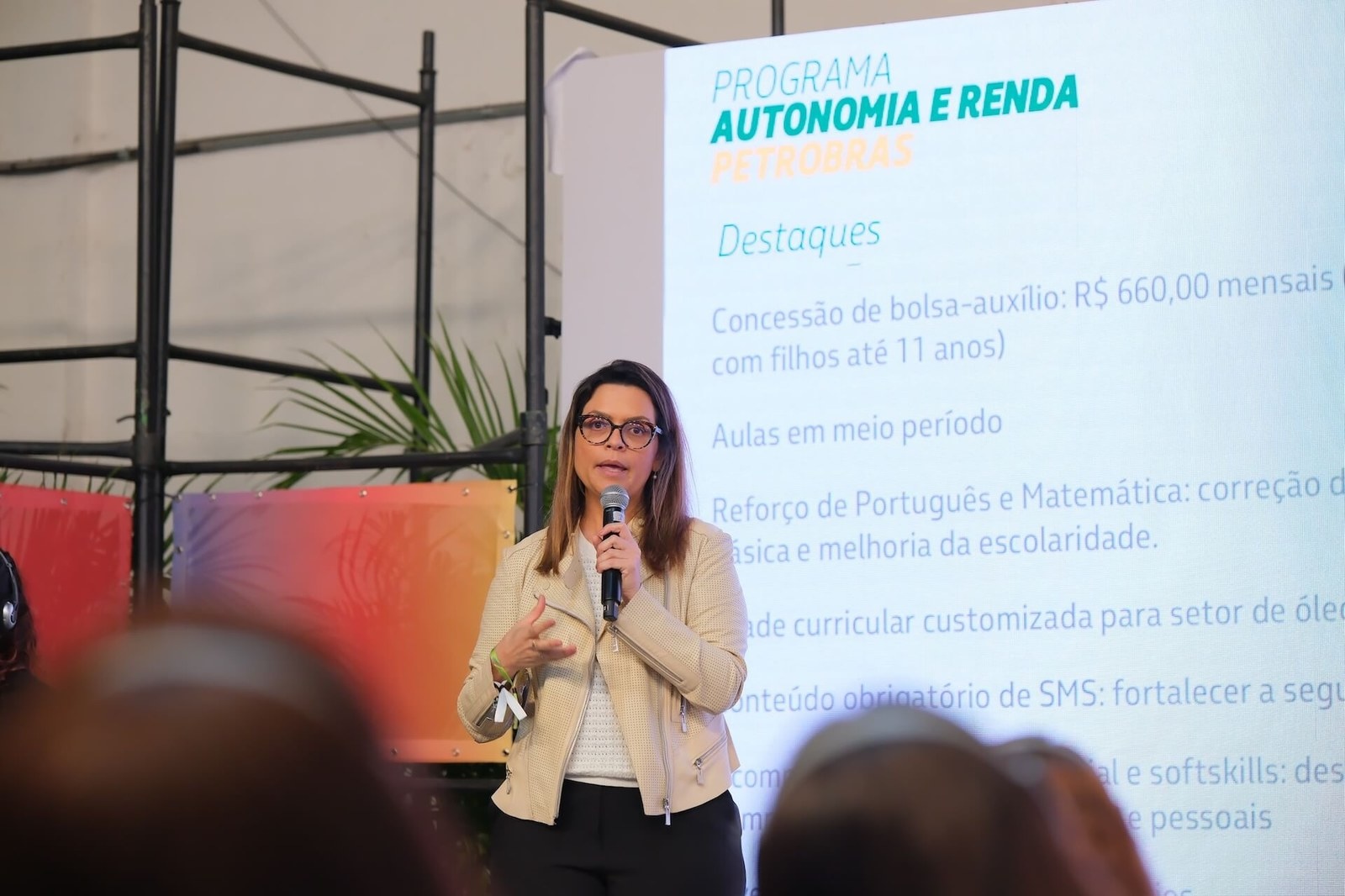
Petrobras launched the Autonomy and Income Program this year to qualify people living in social vulnerability and create more job opportunities in the oil and gas sector. It is already helping 1.200 people who have participated in 38 classes since July. Among the students, 77% are black and brown people; 72% are female—50% of those women have children aged up to 11, and 6% are disabled people. Over 22 thousand people registered—a demand that reflects the program's interest and relevance. "This demand surpassed our expectations. Many women have shown interest in this sector, which is still so masculine; this is meaningful. The course also comprises 39% of people over 35. Our program has no etarism. We need a diverse construction site," added Marcela Levigard, Petrobras's Social Projects Manager, during a presentation at G20 Social this morning (11/14) at Espaço Kobra.
The first classes will graduate by the end of the year, and the students will be available to attend interviews with Petrobras suppliers. The company will invest BRL 350 million in this program within the following years. We expect to offer another 11 openings in 2025; some of those registrations will begin in 2024.
The courses are intended for people with low income or no formal job who live in the neighborhood of Petrobras's operations in seven states: Rio de Janeiro, Espírito Santo, Minas Gerais, São Paulo, Pernambuco, Paraná, and Rio Grande do Sul. In partnership with Senai and Federal Education, Science, and Technologies Institutes, the course teaches subjects in each career, knowledge adapted to the oil and gas sector, occupational and operational safety, and development of social, emotional, and personal skills, in addition to human rights, and tuition in Portuguese and mathematics. The classes are part-time, and students receive a BRL 660.00 allowance (BRL 858.00 monthly for women with children aged up to 11), a measure that helps keep the students in the program until graduation.
Further information on the Autonomy and Income Program and Public Notices can be found on the website www.autonomiaerenda.com.br