Loading
Delegates' Area
English
G20 SOCIAL
A day to remember for the world's largest economies: G20 Social listens to the voices of international civil society
Featuring around 180 self-managed activities on the event's first day (14), the G20 Social proves civil society's organizational capacity and people's willingness to participate in the debates at the G20. A historic event in progress, to be continued by the South African presidency next year.
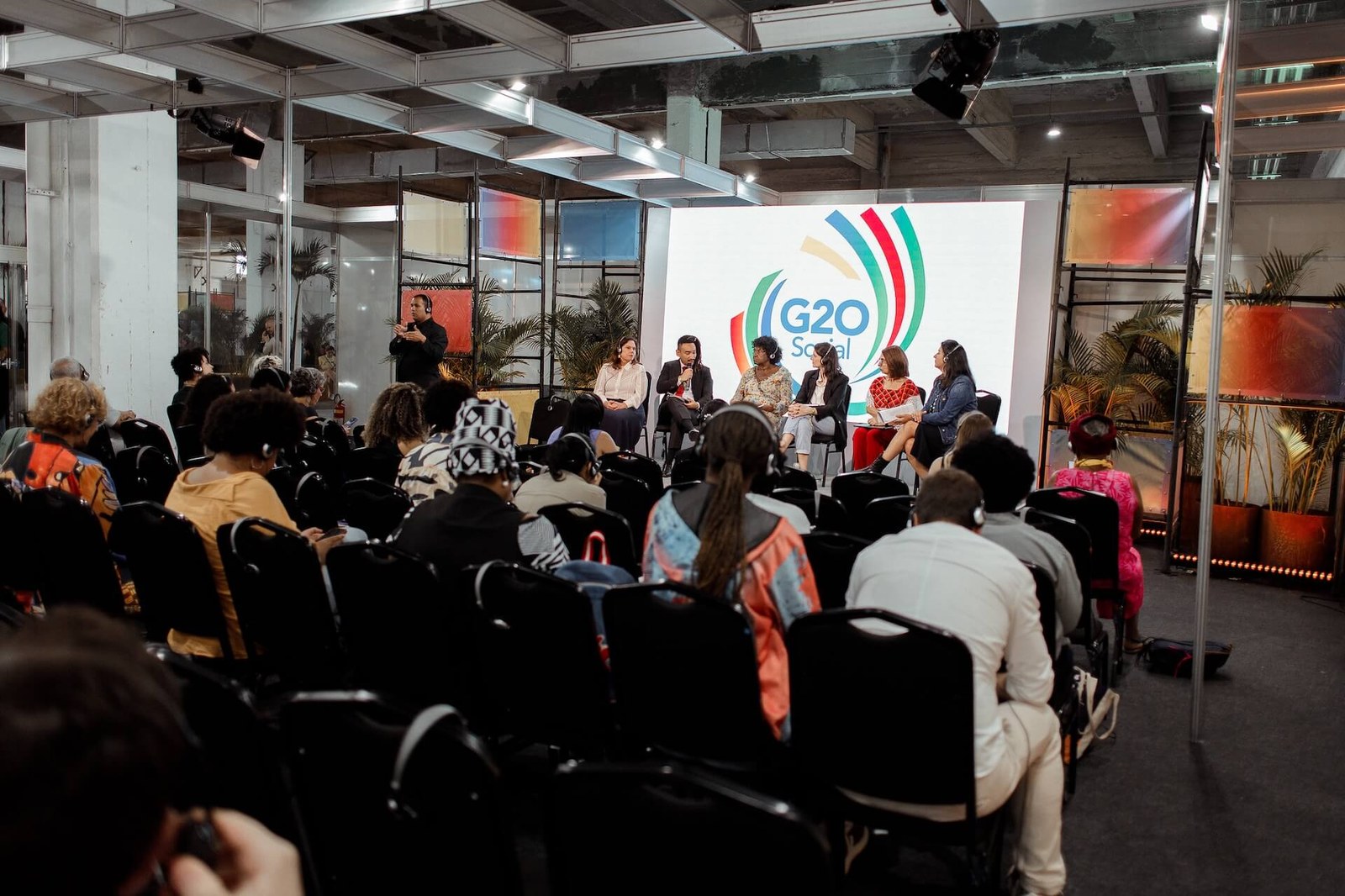
"People aren't interested in politics." An idea often heard at bars, family dinners and academic debates. Spread over decades, classes and borders. But what notion of politics is this phrase actually about? This first day of activities at the G20 Social suggests an answer: people do not like politics that they are not invited to participate in. When invited, they participate.
With thousands of square meters occupied by the most diverse faces and voices, simultaneously debating hundreds of global issues, the world's civil society is showing that they want to participate in political processes, but not simply as beneficiaries of projects approved by public authorities. They do not want to be a figure only mentioned in populist speeches but to be the protagonists of their own agendas, with the power to influence public decisions.
Participating in this unprecedented structure of the G20, around 180 self-organized activities were held on Thursday (14), discussing a wide range of topics. The rights of people living with disabilities; the central role of favelas for international solutions; residence permits for immigrants investing in the green economy; philanthropy for social development; challenges for public investment in combating racism from the perspective of youth; the role of waste pickers in leading the circular economy. These are just some of the activities that took place on Thursday (14).
Summary of activities
The panel “The high return on investing in early childhood to promote human and strategic capital to fight poverty and inequality” discussed how prioritizing the early years of children's lives goes beyond social justice, being a powerful strategy for human and economic development that is essential to overcome cycles of poverty and inequality. “The reality of poverty affects everyone, but especially families with young children. There are 39% of children living below the poverty line,” stated Dandara Ramos, associate professor of epidemiology at the Federal University of Bahia (UFBA).
In the panel "Overcoming inequalities between women and men in the labor market", female leaders from labor unions addressed the urgency of ensuring equal pay, given that this has been mandatory in Brasil since 1943, with the implementation of the Consolidation of Labor Laws (CLT). “We are more than 50% of the population. It's not acceptable to be the majority of voters in the country and nothing else. We have a law that guarantees equal pay and, unfortunately, the employers want to take that away from us,” said Celina Arêas, from the Women's Secretariat of the Central of Male and Female Workers of Brasil (CTB).
“Mapping the biodiversity and archaeology of the Amazon” was the theme of the panel that guided debates on the need for greater support for the protection of territories and the bioeconomy. The panelists pointed out that this edition of the G20 was the first to consider the issue with the proper importance, featuring the first meetings of the forum's Bioeconomy Initiative. “Our pyramids are our forests, the ‘construction’ of our traditional peoples. It is important to understand that it is difficult for tropical countries to figure out how to manage such abundance, and the people of the forests are showing us the way,” said Eduardo Neves, from the Project Amazônia Revelada (Amazonia Revealed).
“Science: the way to combat disinformation and its negative impact on life”, was a panel that highlighted the importance of information integrity for building a democratic, peaceful, inclusive, and sustainable society. The importance of addressing contemporary challenges in a proactive and collaborative manner, as well as the dilemmas of fake news to democratic electoral processes was highlighted. “In several elections, fraudulent images were used to influence public opinion, associating candidates with false ideas and actions,” said Ana Regina Rego, coordinator of the National Network to Combat Disinformation, who presented examples from Brasil, India, the United States, and the European Parliament.
A day to remember
The G20 Social, as a "third track" of the world's largest economic cooperation forum, is an innovation of Brasil's presidency, which will be continued by the South African presidency next year. A historic event in progress, which on the first day of the event has already left its mark on the world's largest economies. It's not about “giving voice”, but “giving an ear”. Civil society has long said that the key to change is to be heard. This is the premise of the meeting held on November 14 in downtown Rio de Janeiro.
The agenda continues on Friday (15) and Saturday (16), featuring various self-managed activities, plenary sessions with national and international authorities, fairs, artistic interventions, and a music festival. Everything and everyone is aligned towards one purpose: a just world and a sustainable planet.
*Translated by PGET-UFSC