Loading
Delegates' Area
English
G20 SOCIAL
Launch of the Favela 20 Recommendations: A milestone for marginalized communities
On November 4, Favela Day achieved a new landmark with the launch of the policy recommendations of Favela 20 (F20), an initiative led by favela communities in Rio de Janeiro to give marginalized territories a voice in international policy debates. The recommendations will be submitted to the Brazilian government and international authorities, reinforcing the role of these communities in the development of public policies.
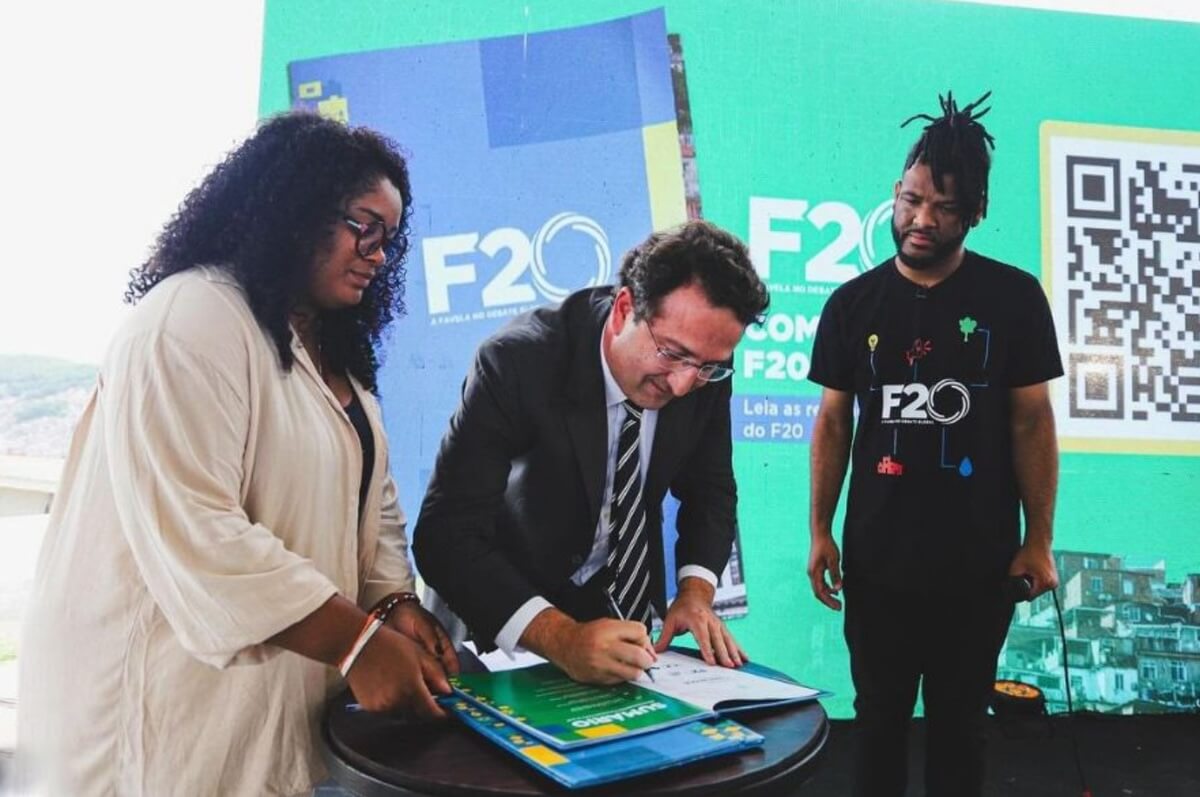
The launch ceremony was held in Complexo do Alemão, in Rio de Janeiro's North Zone, and evoked a quote from Bertolt Brecht: “Never say 'that's natural', so nothing appears to be unchangeable.” The message echoed as a call for transformation, emphasizing that the voices of historically marginalized communities are fundamental in building a more just and sustainable world.
Focusing on the three axes of Brasil's G20 presidency—fighting inequalities, sustainability, and global governance reform—Favela 20 presented recommendations that integrate socioeconomic and environmental challenges. Among the priority agendas are:
•Fighting poverty, hunger and inequalities;
•Promoting mental health and public safety;
•Access to safe drinking-water, sanitation and hygiene;
•Resilience to natural disasters;
•Digital and cultural inclusion;
•Sustainable finance.
For René Silva, co-founder of Favela 20, the inclusion of these agendas in the international debate is a step forward for the representation of favelas: “The voices of marginalized realities are often silenced. Our challenges and our perspectives are pushed aside. We are here to show that favelas are part of the solution and can contribute to significant public policies.”
Putting Favela at the Heart of Decisions
F20 reinforces the central role of favelas and marginalized urban areas in developing lasting policies. Access to basic sanitation, digital technologies, and economic opportunities were highlighted as essential for local development and as a way of combating structural exclusion. Representatives such as André Guterres, from the Rolé Favela Geek project, pointed to the need to guarantee digital inclusion and access to information as a human right, especially in areas affected by internal conflicts.
For Thainar Xavier, from Sebrae Rio, initiatives such as F20 represent a historic movement to demand rights and increase the participation of the people living in favelas, which comprise 22% of Rio de Janeiro's population. Adriana Sotero, from Fiocruz, reinforced that water and basic sanitation are rights that must be defended publicly, emphasizing the importance of a debate on privatization and universal access to these essential services.
Local Challenges, Global Responses
Favela 20 proposes a new approach to sustainable development, recognizing the diversity of challenges faced by each community. Cae Guajajara, an indigenous woman from Complexo da Maré, stressed the role of favelas as spaces of resistance and the importance of creating public policies that respect the particularities of indigenous peoples and Afro-descendants.
This F20 launch sets a milestone for the inclusion of marginalized voices in global politics, bringing solutions proposed by those who live the challenges of their realities on a daily basis. The message is clear. As the writer Carolina Maria de Jesus said: “What hurts me is not who I am, but what others think I am.” The F20 demonstrates that there are more than problems in the favelas, there is also power and innovation for a more inclusive and supportive world.
Translated by PGET-UFSC